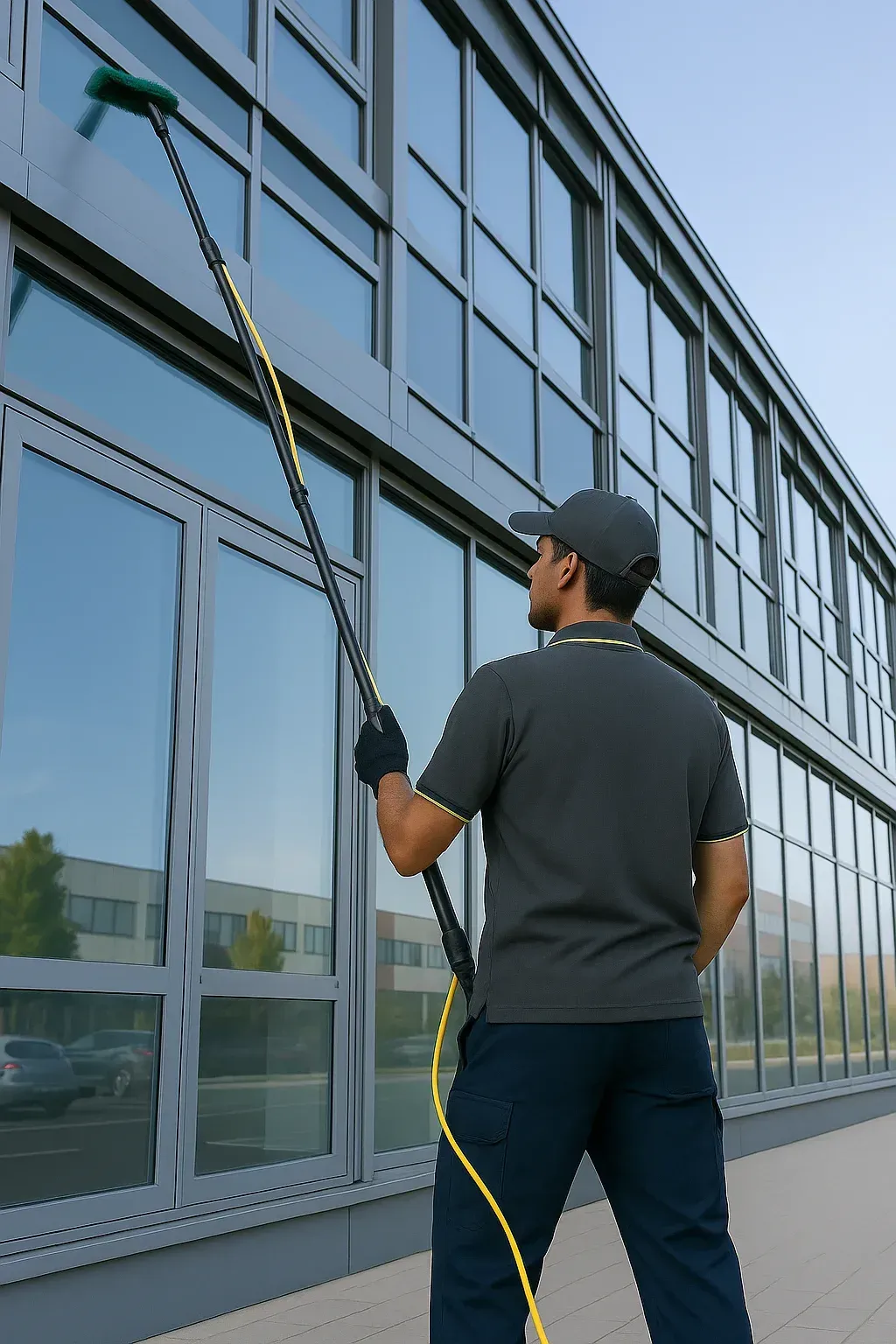
Melbourne commercial window cleaning: access and weather planning
Victorian-focused guidance for facility and property managers on selecting safe access methods, regulator expectations, weather-based scheduling considerations...
Share
This guide is for facility managers, property managers and commercial cleaning contractors in Melbourne responsible for commissioning or carrying out commercial window cleaning. It covers access method selection, Victorian safety expectations, weather-based scheduling considerations for Melbourne, and core elements to include in a site-specific Safe Work Method Statement (SWMS).
Scope and boundaries: guidance applies to Victoria; Australian Standards referenced (AS/NZS 1576.1, AS/NZS 1892) are recognised industry benchmarks but are not themselves law; weather guidance reflects typical Melbourne conditions and excludes extreme events; the focus is commercial window cleaning and excludes residential, industrial manufacturing and specialised rope access techniques.
Regulator boundary: WorkSafe Victoria enforces Victoria’s OHS duties and related compliance. The Victorian Building Authority (VBA) regulates building and plumbing matters that can intersect with access systems. Safe Work Australia provides national model guidance on risk management and working at height (guidance, not enforcement). Always check WorkSafe Victoria and (where relevant) the VBA for binding Victorian requirements, and consult manufacturer instructions for plant limits.
Use this single-page checklist when mobilising. It summarises access, weather, permits, SWMS and emergency planning.
Access method: match building height, façade type and site constraints to scaffold, MEWP/boom lift, temporary edge protection or ladder (see Access methods). Select based on site-specific risk assessment and manufacturer/regulator guidance.
Weather go/no-go: do not proceed if conditions exceed equipment manufacturer limits or create unsafe surfaces; document the site-specific decision criteria and reference manufacturer and regulator guidance in the SWMS.
Permits and notifications: confirm building owner/strata approval and any loading zone or council permits that may be required for your specific location.
SWMS and rescue plan: have a site-specific SWMS prepared and implemented as required under applicable OHS/WHS duties; include an emergency/rescue plan appropriate for the chosen access method.
Inspections and records: complete pre-use equipment checks and retain inspection/maintenance records as required by manufacturer instructions and any statutory obligations; AS/NZS standards are recognised benchmarks (not law). Confirm binding record-keeping expectations with WorkSafe Victoria/VBA. Ensure operator competencies and any required licences/registrations are confirmed with the manufacturer and WorkSafe Victoria/VBA.
Key contacts: site manager, building security, nominated rescue team and weather lead.
Access methods and when to use them
Choose access based on building height, façade type and site constraints (laneways, loading docks, pedestrian traffic). Common options for Melbourne commercial buildings:
Scaffolding: suited to mid-rise façades, heritage buildings and extended works where a stable platform and edge protection are needed. Refer to AS/NZS 1576.1. Pros: collective fall controls; Cons: setup time, space and permit needs.
Mobile elevated work platforms (MEWPs): suitable for medium to high façades where ground placement is possible and frequent repositioning is required. Check manufacturer wind limits and relevant regulator guidance. Pros: mobility and speed; Cons: ground loading and exclusion zones; confirm operator competence and any applicable licensing/registration with the manufacturer and WorkSafe Victoria/VBA.
Boom lifts: use for greater reach or when obstacles prevent direct access. Require competent operators, pre-use inspections and appropriate exclusion zones; confirm any licensing/registration and record requirements with the manufacturer and WorkSafe Victoria/VBA.
Ladders: limited to low-level, short-duration tasks and should meet AS/NZS 1892. Avoid ladders for repeated, elevated or exposed glazing work where collective controls are reasonably practicable.
Temporary edge protection/roof access: for rooftop façade cleaning or work from a roof edge; requires competent installation and emergency/rescue planning.
Recommendation: map the building during planning — note façade material (curtain wall, framed glazing, masonry), adjacent vehicle/pedestrian flows, and anchor or ground-placement constraints. Prefer options that minimise time at height and provide collective fall controls where practical. Justify the selected access method in the SWMS based on site-specific risks and applicable standards/manufacturer guidance.
Regulatory and standards overview (Victoria)
Key responsibilities and references for Victoria:
Statutory duties (enforced): In Victoria, OHS laws and working-at-heights obligations are administered and enforced by WorkSafe Victoria. Where building or plumbing regulation is relevant (e.g., fixed access systems), the Victorian Building Authority (VBA) may apply. For binding obligations, consult these regulators and seek legal advice if needed.
National guidance (not enforced law): Safe Work Australia publishes model codes and guidance on risk management and working at height. These documents inform good practice but are not directly enforceable in Victoria.
Recognised standards and manuals: AS/NZS 1576.1 (scaffolds) and AS/NZS 1892 (ladders) are widely recognised benchmarks. Always follow equipment manufacturer manuals for plant limits and operation. Standards and manuals guide practice but do not replace legal duties.
Roles and responsibilities: Contractors control the work and must implement safe systems (risk assessment, SWMS, competence, PPE, plant inspection/maintenance). Building owners/managers control the premises (site access, permissions, anchors/roofs) and should coordinate access and permit arrangements. Document who does what before work begins.
Reference links: Safe Work Australia (guidance) and the Victorian Building Authority (building safety). Confirm current WorkSafe Victoria materials for enforceable, state-specific duties and see our Commercial cleaning pillar for related services.
Weather planning for Melbourne — practical rules
Melbourne conditions change quickly. Use forecast monitoring and define site-specific decision triggers that reference manufacturer limits and regulator guidance.
Wind: check sustained and gust wind speeds and compare to equipment manufacturer limits. Numeric thresholds must come from the specific plant manuals and your site risk assessment; this guide does not set universal or legal cut-offs.
Rain and wet surfaces: avoid external glazing work during rain or while surfaces are wet enough to create slip or tool-control hazards; note that some plant operation manuals restrict use in wet conditions.
Temperature and heat stress: apply controls on hot days (shade, hydration, rest breaks). Consider rescheduling when heat-stress risks are significant; include your heat-stress policy in the SWMS.
Cold and icy conditions: suspend roof-edge or elevated work where freezing or icy surfaces are likely to create an unacceptable hazard.
Monitoring: nominate a weather lead, use Bureau of Meteorology forecasts and document the decision-making process in the SWMS.
Record weather triggers, who authorises stop-work and the rescheduling process with the building manager before mobilisation. Always defer to equipment manufacturer limits and applicable regulator guidance.
SWMS and permit essentials
Prepare a site-specific SWMS and complete permit checks before work starts. Core SWMS elements:
Scope of work and tasks involving working at heights.
Access method justification and controls, with reference to manufacturer and recognised standards where applicable.
Risk assessment for falls, falling objects, traffic interaction, weather and site-specific hazards (heritage fabric, overhead services).
PPE required and standards referenced.
Plant and equipment inspections, tagging and maintenance records as required by manufacturer instructions and applicable regulator guidance.
Emergency and rescue plan: roles, rescue equipment, contact details and response arrangements for the chosen access method.
Weather contingency actions and decision triggers (who authorises stop-work and reschedule) documented for the site.
Training and competency records for operators (document operator competencies and any required licences/registrations) and other workers as applicable.
Communication and permit checks with building owner/manager, security and any relevant council or traffic authorities.
Sign-off fields or records as appropriate for the contracting arrangements and regulatory expectations; record who prepared and implemented the SWMS.
Permit checklist before mobilisation: written building/strata permission where required; any loading zone or footpath occupation permits as applicable (confirm with the relevant local council); insurance cover verification (a common contractual/commercial control — confirm with your insurer and building owner/manager); traffic management plan if required; and confirmation of rescue/responder arrangements.
Site-access logistics and Melbourne examples
Three common Melbourne scenarios with practical checks:
CBD high-rise with loading dock constraints: requirements vary by municipality — confirm with the local council for the subject property. Check loading-zone availability and any council permit requirements for street works; verify ground bearing capacity for MEWPs, set pedestrian exclusion zones and confirm security and after-hours access arrangements.
Inner-city heritage façade: scaffolding is often preferable; confirm permissions for fixed anchors and measures to protect heritage fabric. Consider involving the owner or a heritage adviser as required.
Suburban office park: check vehicle access for booms/MEWPs, underground services in lawns, and coordinate with estate management for site traffic routes and neighbour notification if closures are needed.
Photograph access routes and exclusion zones and attach images to the SWMS to reduce ambiguity at handover.
PPE, inspections and certification
Align PPE and equipment checks to standards, manufacturer requirements and regulator guidance.
PPE commonly required: items often specified include a safety helmet, a certified harness and lanyard where fall-arrest or restraint is used, high-visibility clothing, gloves suitable for wet work, slip-resistant footwear and eye protection. Specify relevant standards in the SWMS and confirm any mandatory PPE expectations in regulator guidance or site rules.
Inspections: conduct pre-use checks for MEWPs, boom lifts and scaffolds each shift; follow manufacturer instructions and AS/NZS guidance for periodic formal inspections and tagging where applicable. Retain inspection records in the job file and confirm statutory record-keeping expectations with WorkSafe Victoria/VBA.
Certification and training: operators must be competent; retain evidence of training and any required licences/registrations, and keep plant maintenance records as required by regulator guidance and manufacturer manuals. Confirm specifics with WorkSafe Victoria/VBA.
Refer to AS/NZS 1576.1 and AS/NZS 1892 as recognised standards for scaffolds and ladders; confirm current editions and applicable guidance from regulators.
Appendix: templates, decision prompts and links
SWMS template bullets:
Task description, location and date.
Access method and justification (site-specific).
Identified hazards and control measures.
Emergency/rescue roles and equipment.
Weather stop/work triggers and decision authority (site-specific, referenced to manufacturer/regulator guidance).
PPE list and plant inspection record placeholders.
Record of who prepared/implemented the SWMS.
Example weather decision prompts (illustrative only — not legal limits):
Compare current sustained and gust wind speeds to equipment manufacturer limits and documented site thresholds; proceed if within limits and controls are in place.
If conditions approach plant limits or create slippery surfaces, implement additional controls, reduce exposure time or suspend elevated operations.
If conditions exceed plant or safety thresholds, suspend works and reschedule.
Permit request example language (generic, illustrative only — councils/building owners may require different details): "Requesting approval to undertake external window cleaning at [address] on [date]; proposed access method: [scaffold/MEWP]; please confirm loading zone and building contact." Modify to suit local council and building requirements.
Who is responsible for arranging permits and site access for commercial window cleaning in Melbourne?
Contractually, parties should agree who applies for council/building permits and books access. Statutorily, contractors must ensure work is carried out safely (SWMS, competence, plant and PPE) under OHS duties enforced by WorkSafe Victoria. Building owners/managers control the premises and may have duties regarding building safety and access systems. Confirm arrangements in writing and check any building-regulatory aspects with the VBA where relevant.
What wind speed should stop work for external window cleaning?
There is no universal legal wind-speed limit. Compare measured sustained and gust wind speeds to the specific equipment manufacturer limits and site-specific thresholds documented in the SWMS, and follow regulator guidance when making stop-work decisions.
What must a site-specific SWMS for window cleaning include?
Core elements: scope and tasks, chosen access method and justification, identified site hazards and controls, PPE, plant inspection and maintenance records, emergency/rescue arrangements, weather contingency triggers, training/competency evidence (and any required licences/registrations) and records showing who prepared and implemented the SWMS.
Can ladders be used for commercial window cleaning?
Ladders may be appropriate only for low-risk, short-duration tasks and should meet AS/NZS 1892 guidance. Where reasonably practicable, collective controls such as scaffolding or MEWPs are preferred for repeated or elevated work.
Where can I check current Victorian requirements and recognised standards?
For enforceable duties, check WorkSafe Victoria. For building-related safety/regulatory aspects, check the VBA. Use Safe Work Australia for national model guidance. Refer to AS/NZS 1576.1 and AS/NZS 1892 for recognised scaffold and ladder benchmarks.
Get a free estimate
Need professional cleaning?
Get a free, no-obligation quote. Fixed price, same team every visit, no lock-in contracts.