Building a periodic cleaning calendar for commercial facilities
Practical Australia‑relevant framework to design a 12‑month, risk‑based cleaning calendar for carpets, windows, floors and pressure cleaning that aligns with WHS...
Share
Use this risk‑based framework to map a 12‑month cleaning calendar that preserves assets, reduces WHS hazards and avoids reactive work – for facility, operations and procurement leads in offices, retail and light‑industrial sites. Note: cleaning frequencies are not set by law; set final schedules via site risk assessment, manufacturer instructions and local environmental rules.
Why a periodic cleaning calendar matters (WHS, asset life, efficiency)
Planned cleaning helps PCBUs meet outcome‑based WHS duties to identify hazards and implement reasonably practicable controls. Safe Work Australia provides guidance for cleaning risks and WHS controls but does not prescribe fixed cleaning intervals. Proactive maintenance also supports asset‑management principles and warranty care by following manufacturer instructions.
Standards Australia publishes technical standards that inform methods and safety. Relevant examples include: AS/NZS 3733 (textile floor coverings – cleaning maintenance), AS 4586 and AS 4663 (slip resistance classification/measurement of pedestrian surfaces), AS 4233.1/4233.2 (high‑pressure water jetting – safe use) and AS/NZS 1891 and AS/NZS ISO 22846 (fall‑arrest and industrial rope access for facade/window work). These are guidance unless referenced in contracts or regulations.
Sources: Safe Work Australia – Cleaning; business.gov.au – Maintenance planning; Standards Australia catalogue (see Further resources).
Access and WHS constraints (work at height, plant, pedestrian segregation).
Environmental limits (state water restrictions, council stormwater/discharge rules) and suitable detergents/recovery methods.
Budgets, contractor availability and peak/low‑use windows.
Use Safe Work Australia guidance to ensure workers/contractors have the necessary information, training, instruction and supervision, and apply maintenance‑planning principles from business.gov.au.
Where this task applies, include commercial window cleaning as a separate line item with its own condition trigger and timing.
Recommended frequency ranges by task (qualitative, risk‑based)
Australian WHS guidance and standards do not mandate numeric cleaning intervals. Set frequencies using risk, manufacturer instructions and monitoring data. Typical practice descriptions:
Commercial carpets: Routine dry soil removal (e.g., vacuuming) at a cadence matched to footfall; prompt spot/stain treatment; periodic interim maintenance; and scheduled deep cleaning. Refer to AS/NZS 3733 for recognised cleaning maintenance guidance for textile floor coverings and follow carpet manufacturer instructions.
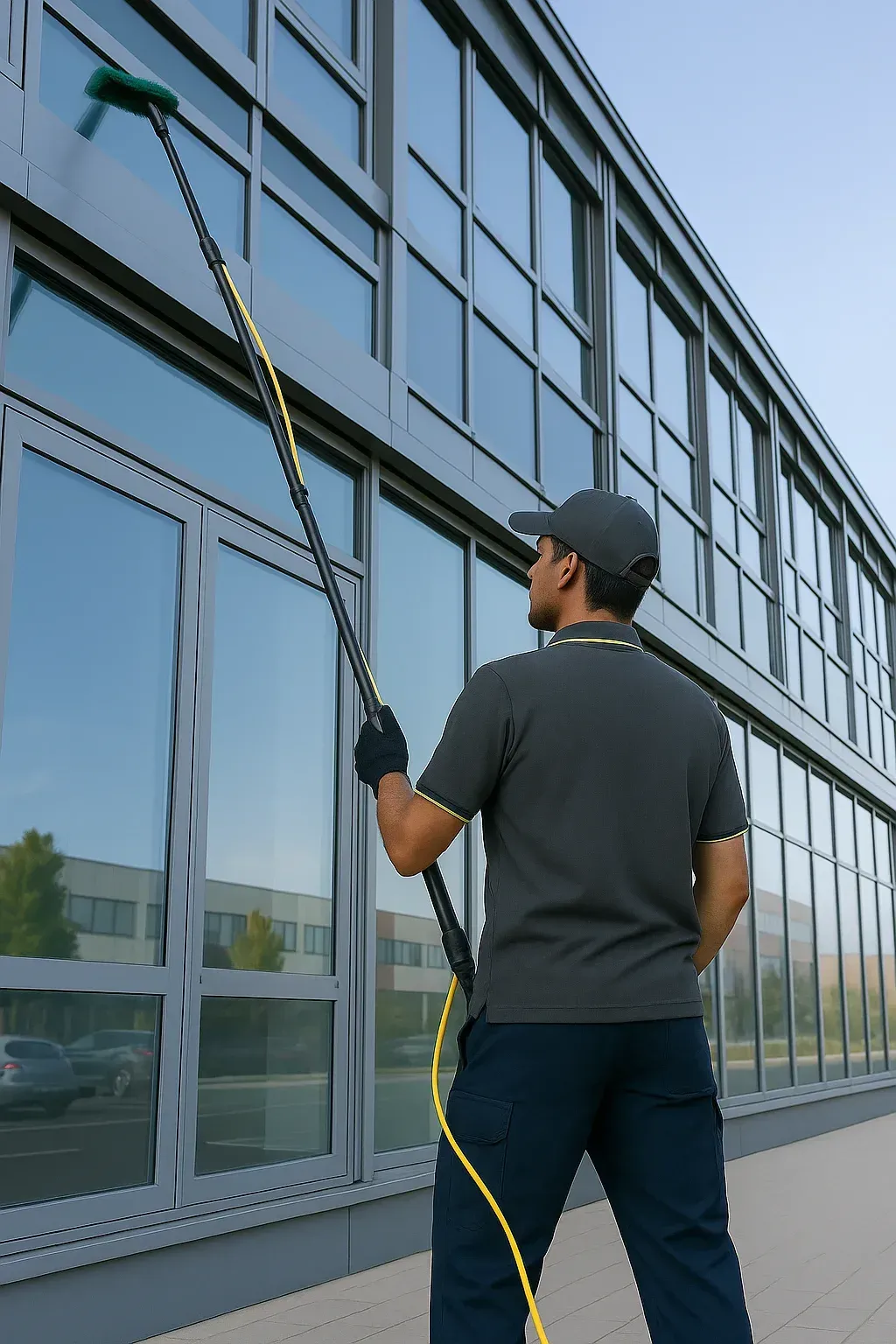
Windows/facades: Cadence varies by exposure (traffic, salt, pollution) and access method. For elevated work, plan in accordance with fall‑arrest (AS/NZS 1891) or industrial rope‑access practice (AS/NZS ISO 22846) and applicable WHS controls.
Internal hard floors: Daily/regular dust control and damp cleaning; periodic maintenance (e.g., scrub/recoat) based on wear and product data. Manage slip risk and verify performance with recognised slip‑resistance standards (AS 4586 for new materials; AS 4663 for existing surfaces measurement) where relevant.
Pressure cleaning (external pavements, facades): Schedule as needed to control buildup, appearance and safety. Use equipment and methods consistent with AS 4233.1/4233.2 (high‑pressure water jetting – safety). Confirm water restrictions, runoff containment and permits before work.
Where this task applies, include commercial carpet cleaning as a separate line item with its own condition trigger and timing.
Risk‑based decision matrix (how to choose frequencies)
Apply a simple tiered approach and calibrate with evidence:
Tiers: High (heavy footfall or high contamination/safety sensitivity); Medium; Low. Set initial cadences accordingly (e.g., more frequent interim tasks in High zones).
Validate: collect 3+ months of occupancy/soil data and appearance/slip observations; review manufacturer schedules; pilot and record outcomes (appearance, incidents, warranty feedback); adjust and review periodically.
12‑month sample calendar and editable template
Example task groupings (adapt to risk and access windows):
Note: Any downloadable template provided on this site will be covered by the site’s privacy notice.
Procurement and contract guidance
Example clauses (illustrative only):
Scope and frequencies: “Frequencies will be set by documented site risk assessment, manufacturer instructions and performance reviews. Where standards are referenced (e.g., AS/NZS 3733; AS 4233; AS 4586/AS 4663; AS/NZS 1891; AS/NZS ISO 22846), methods must conform.”
WHS compliance (regulatory duty): Require compliance with WHS laws and applicable Codes of Practice. Require SWMS where applicable and safe systems of work.
Contractor competency (procurement control, not a universal legal mandate): Specify the evidence you will accept (e.g., demonstrated experience, manufacturer/product training, relevant high‑risk licences, and where applicable training for fall‑arrest/rope access or high‑pressure water jetting). Safe Work Australia expects PCBUs to ensure workers/contractors receive necessary information, training, instruction and supervision; your contract can require proof of this.
Environmental controls (regulatory): Contractor to comply with state water restrictions and council stormwater rules; define detergent approval, wastewater capture, and who obtains permits.
Performance and review: Define KPIs, inspections/rectification, and a review to adjust frequencies based on monitoring data.
Compliance and local constraints
Key points:
WHS (regulatory): Duties are outcome‑based; there are no regulator‑mandated cleaning intervals. Follow Safe Work Australia guidance and relevant Codes; consult your state/territory WHS regulator for local detail.
Standards (guidance unless referenced): Use recognised standards for methods/safety: AS/NZS 3733 (carpets), AS 4586/AS 4663 (slip resistance), AS 4233.1/.2 (high‑pressure water jetting safety), AS/NZS 1891 and AS/NZS ISO 22846 (fall‑arrest and rope access). They become binding only if cited in contracts/regulations.
Environmental rules (regulatory): Confirm water restrictions, runoff containment and permit needs before pressure cleaning. Representative links: NSW (Sydney Water – Water Wise Rules), Victoria (Water restrictions – water.vic.gov.au), Queensland (Urban Utilities – Waterwise), Western Australia (Water Corporation – Waterwise), South Australia (SA Water – Water Wise Measures), ACT (Icon Water – Water conservation), Tasmania (TasWater – Water restrictions), Northern Territory (Power and Water – Water restrictions).
Tailoring: Adapt for sector specifics, building access, climate and local rules.
Further resources & links
Safe Work Australia – Cleaning: https://www.safeworkaustralia.gov.au/topic/cleaning
Safe Work Australia – Information, training, instruction and supervision: https://www.safeworkaustralia.gov.au/topic/information-training-instruction-and-supervision
Model Code of Practice – Managing the risk of falls at workplaces: https://www.safeworkaustralia.gov.au/resources-publications/model-codes/model-code-practice-managing-risk-falls-workplaces
Standards Australia catalogue (search by number): AS/NZS 3733 (textile floor coverings – cleaning maintenance); AS 4586 (slip resistance – new surfaces); AS 4663 (slip resistance – existing surfaces); AS 4233.1 and AS 4233.2 (high‑pressure water jetting – safety); AS/NZS 1891 (industrial fall‑arrest systems); AS/NZS ISO 22846 (industrial rope access systems). Browse: https://www.standards.org.au/standards-catalogue
Representative water restriction resources: Sydney Water – https://www.sydneywater.com.au/waterwise; Victoria – https://www.water.vic.gov.au/liveable/water-restrictions; Urban Utilities (QLD) – https://urbanutilities.com.au/waterwise; Water Corporation (WA) – https://www.watercorporation.com.au/Help-and-advice/Waterwise; SA Water – https://www.sawater.com.au/waterwise; Icon Water (ACT) – https://www.iconwater.com.au/water-and-sewerage/water-conservation; TasWater – https://www.taswater.com.au/Community/Water-restrictions; Power and Water (NT) – https://www.powerwater.com.au/customers/save-water/water-efficiency/water-restrictions
Questions facilities teams ask
Commercial cleaning FAQs
How often should high‑traffic commercial carpets be professionally cleaned in Australia?
There is no regulator‑mandated frequency. Set cadence by site risk, soil load and warranty/manufacturer instructions, using AS/NZS 3733 as recognised maintenance guidance.
What are the legal obligations under WHS laws for commercial cleaning schedules?
PCBUs must manage cleaning risks and provide information, training, instruction and supervision. WHS laws do not set numeric cleaning intervals; use a documented risk assessment.
Can pressure cleaning be scheduled year‑round?
Only if it complies with local water restrictions and environmental rules. Check your state water authority/council pages and plan methods consistent with AS 4233.1/4233.2.
How do I build a calendar that covers carpets, windows, floors and pressure washing?
Map zones by footfall/contamination, align methods with manufacturer/standards, plan WHS controls for access, check water/permit limits, pilot the cadence and adjust from results.
Where can I find official Australian guidance or standards?
See Safe Work Australia (cleaning and training/supervision guidance), business.gov.au (maintenance planning) and relevant Standards Australia documents cited above.
Get a free estimate
Need professional cleaning?
Get a free, no-obligation quote. Fixed price, same team every visit, no lock-in contracts.