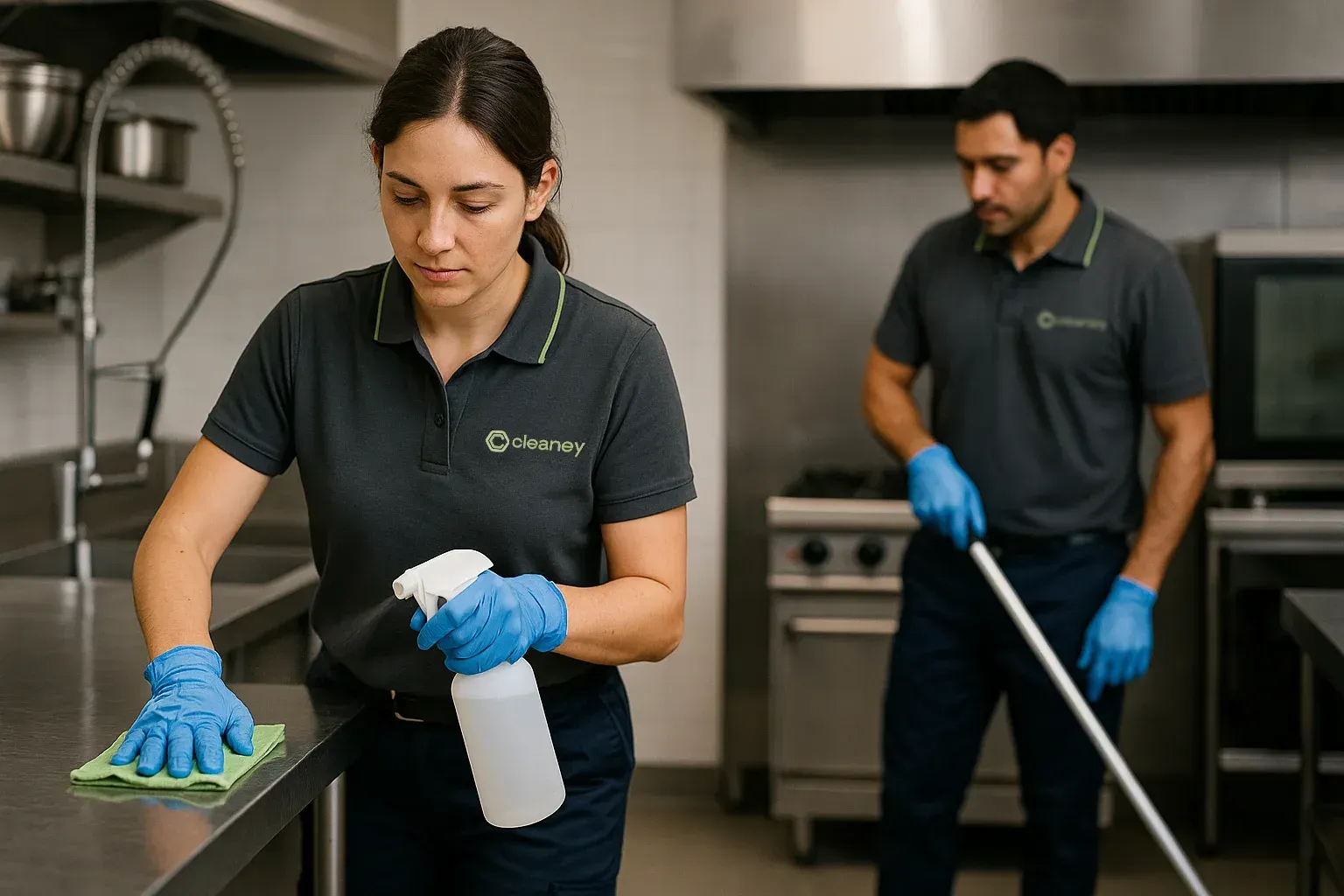
This guide helps Australian restaurant owners, kitchen supervisors, facilities managers and landlords allocate responsibility for cleaning: everyday staff tasks, scheduled deep cleans and specialist canopy/exhaust work. It distinguishes statutory duties (Food Standards Code, WHS laws) from non‑statutory Australian Standards that inform accepted practice, and sets out CLEANEY operational recommendations so you can build an auditable, risk‑based plan.
Scope: responsibilities and CLEANEY-recommended starting frequencies for daily cleaning, periodic deep cleaning (including equipment disassembly and high-level cleaning) and commercial canopy/exhaust systems. Audience: small to multi-site restaurant operators, head chefs, facilities and compliance officers in Australia. Outcomes: an operational responsibility matrix, triggers for contractor engagement, evidence to request from canopy specialists, and a summary of legal and WHS risks.
Use this as a starting point and adjust for site size, volume, lease terms and local authority requirements. Frequencies below are CLEANEY-recommended starting points, not universal rules. Determine exact schedules from site risk assessments, manufacturers' instructions and applicable Standards/regulator guidance.
Examples: a low-volume café may shift some monthly tasks to quarterly; large multi-site kitchens commonly keep daily tasks in-house and engage specialists for deep cleans and canopy work according to a documented, risk-based schedule.
Who: kitchen staff and duty supervisors. Purpose: immediate hygiene and food-safety control. These operational controls help meet obligations under the Food Standards Code and WHS duties.
Use shift checklists and supervisor verification to support record-keeping. If tasks involve confined-space, electrical or heavy-grease hazards, follow Safe Work Australia guidance (hazardous substances and confined spaces) and engage a competent person or contractor as required under WHS laws; document the assessment and controls.
Deep cleaning includes equipment strip-down, grout and tile restoration, high-level cleaning and intensive grease removal to reduce cumulative food-safety and fire risk.
Document the agreed scope and acceptance criteria before work starts to support auditability and WHS compliance.
Context and Standards
What to request from a canopy/exhaust specialist
Key risks: food contamination, chemical incidents, slips and trips, and fire from grease accumulation. Distinguish obligations and practical controls:
Escalate non-conformance affecting food or fire safety to management and, where required, to the local council or fire authority. Use documented risk assessments to justify chosen frequencies and contractor engagement.
Template overview: a spreadsheet that maps tasks (rows) against frequency columns (daily, weekly, monthly, quarterly, annual) and owner columns (staff, supervisor, contractor, landlord). It includes time estimates, required records and a trigger column for contractor engagement.
Access note: the responsibility matrix and scheduling calendar are CLEANEY practical tools with recommended starting points to adapt via site risk assessment. They support—but do not replace—your legal obligations or the application of relevant Standards and regulator guidance.
What to look for and how to brief them
Supervisors should inspect completed works against the agreed criteria and retain signed reports as evidence of compliance efforts.
Typical allocations (subject to lease wording):
Clarify responsibilities in writing during lease negotiation or renewal and insert inspection/reporting obligations for shared systems to avoid disputes.
Short answers to common operational questions about responsibilities, frequencies and Standards are provided below. Note: answers distinguish statutory duties (Food Standards Code, WHS) from CLEANEY operational recommendations and Standards-based guidance.
Map tasks at your site using the risk-based matrix guidance above, identify when specialist contractors are required and ensure contractor evidence references relevant Standards where applicable. Keep records to demonstrate due diligence for audits and local inspections. Consider an initial specialist canopy assessment when grease accumulation or access is uncertain; set frequencies from that assessment and document the rationale.
Day-to-day hygiene and immediate food-safety cleaning (benches, equipment exteriors, dishes, waste and spill response) are primarily handled by in-house staff and supervisors, with supervisors verifying checklists. Engage a competent contractor when tasks pose access, confined-space or specialist hazards in line with WHS guidance.
CLEANEY-suggested bands are monthly to quarterly for many deep-clean items, and quarterly to annual for full canopy/duct cleans depending on grease load. Set exact timing from a site risk assessment, manufacturer instructions and applicable Standards/regulator advice.
In-house staff handle routine surface cleaning, dishwashing and basic equipment exterior cleaning. Contractors are typically engaged for strip-down equipment cleans, high-level access, heavy grease removal and full canopy/ductwork cleaning when specialist access, ventilation expertise or formal reporting is required.
Request proof of experience, public liability and workers' compensation insurance, a safety method statement, SDS for chemicals used, and a written report with before/after photos and any corrective actions. Where relevant, reports can reference how the work aligns with AS 3666.2-2011 and AS 1851-2012.
They are non-statutory Standards that guide ventilation hygiene, microbial control and routine servicing expectations, including inspection and documentation. Operators can incorporate them into contracts and audits to define performance and verification.
Risks include foodborne illness and regulatory action under the Food Standards Code, workplace injury or chemical incidents under WHS duties, and fire risk from grease build-up with potential action by fire authorities or councils. Maintain records and act on non-conformances to demonstrate due diligence.
Leases may allocate responsibility for building-level plant or shared ducts to the landlord, while tenants usually manage internal hoods and day-to-day cleaning. Confirm and document responsibilities in lease or service schedules.
Use appropriate sanitisers, keep SDS on site, store chemicals away from food, and provide PPE and training. Follow Safe Work Australia guidance on hazardous substances and labelling.
Yes. CLEANEY offers a downloadable responsibility matrix and scheduling calendar with recommended starting points and record fields. Adapt it via site risk assessment; it does not replace legal obligations or relevant Standards.
Get a free, no-obligation quote. Fixed price, same team every visit, no lock-in contracts.
