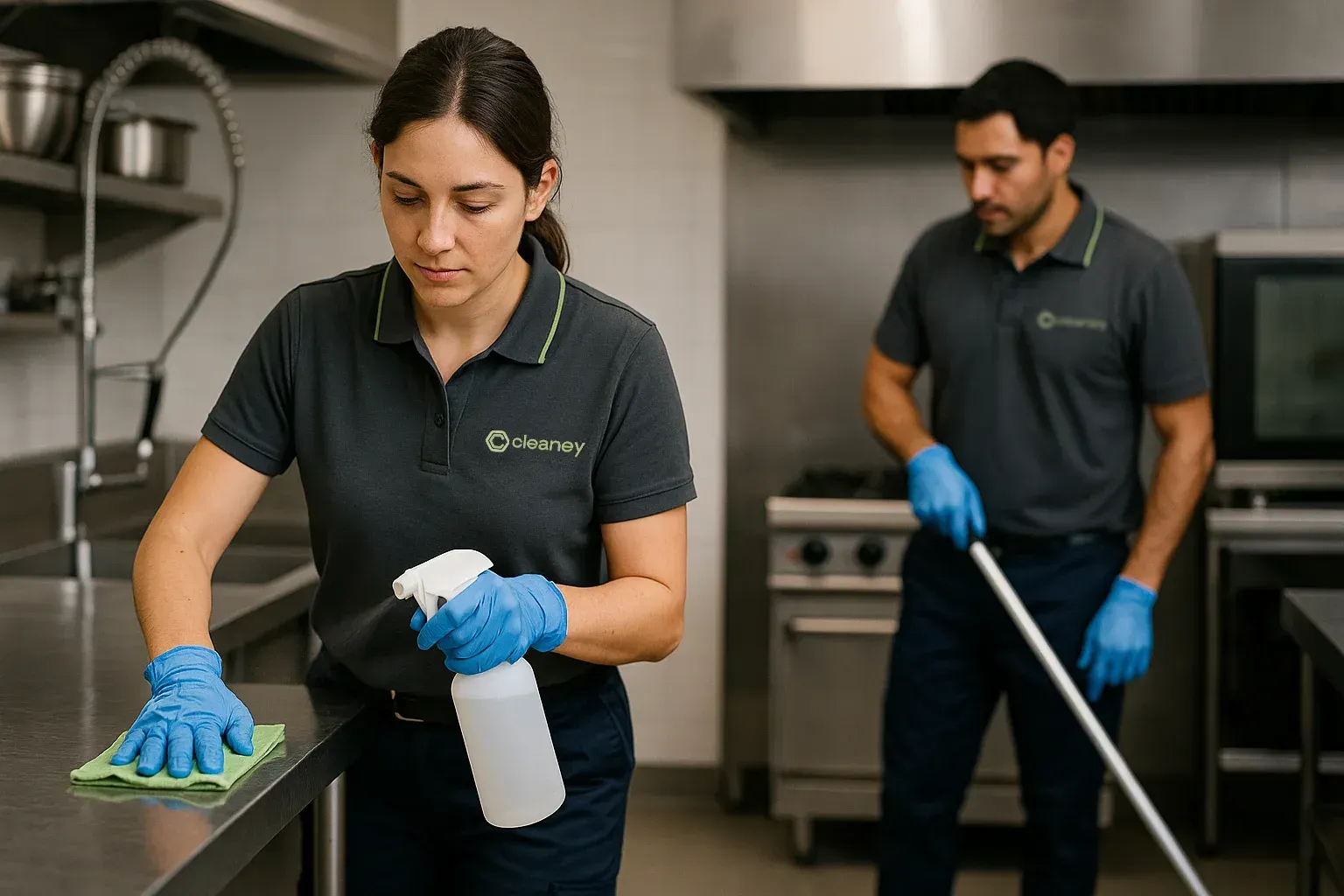
Shutting down for a thorough deep clean is an effective way to remove entrenched grease, biofilm and contamination risks before reopening. This plan focuses on one-off shutdown deep cleans for restaurants and commercial kitchens — not routine daily cleaning — and draws on regulator guidance (Safe Work Australia and the Australian Government Department of Health) and recognised AS/NZS 4146 cleaning principles to inform operational practice. Note the distinction: statutory obligations (for example, WHS duties and state/territory food acts enforced by local councils) differ from regulator guidance and from the operational recommendations provided here. AS/NZS 4146 provides industry-recognised methods but does not itself create legal obligations. Check local jurisdictional requirements and seek legal or professional advice where needed.
For contractor bookings or quotes see our restaurant cleaning services, and for technical procedures specific to kitchen equipment visit our commercial kitchen cleaning page. Use the deep-clean scope checklist below to compare quotes and agree on handover checks.
Scope: shutdown deep cleaning tasks that require full or partial venue closure, including canopy and ductwork degreasing, fryer and oven stripping, floor and drain descaling, coolroom sanitisation and comprehensive high-touch and waste area cleaning. Audience: owners, managers, head chefs, facilities staff and cleaning supervisors. Compliance context: operators must meet statutory obligations under applicable WHS and food-safety laws in their jurisdiction. Use Safe Work Australia (cleaning guidance) and the Australian Government Department of Health (cleaning in food premises) guidance to inform safe methods; AS/NZS 4146 provides recognised cleaning principles. This document provides national operational templates and industry recommendations and is not a substitute for local legal/regulatory advice or professional occupational hygiene assessment.
Prepare with a documented plan covering hazards, stakeholders and resourcing. Key planning elements to record and communicate include:
High-priority zones concentrate grease, food residues and microbial build-up and where failures pose food-safety or fire risks. Typical tasks and methods are listed by area.
Where mechanical cleaning does not remove grease or biofilm, combine alkaline degreasing with manual agitation or controlled steam to disrupt residues prior to sanitisation, consistent with AS/NZS 4146 principles. Confirm compatibility of methods with equipment manufacturers' instructions.
Select agents with SDS available onsite and appropriate for the surface and food-safety context. Recommended types and notes:
Recommendation: use food-grade sanitants for surfaces that contact food, consistent with the Australian Government Department of Health’s guidance on cleaning in food premises. Pretest products on an inconspicuous area; maintain an inventory with SDS and dilution protocols; and follow manufacturer instructions for equipment cleaning, noting some parts may be water-sensitive. Consult your local council/trade-waste officer before discharging cleaning solutions to sewer systems or stormwater, and verify compatibility with any equipment warranties or manufacturer requirements.
Actual durations depend on soiling level, staffing skills and equipment. The following are illustrative planning ranges only (use for initial scheduling; obtain contractor quotes or conduct a site-specific time study for firm estimates):
Task-level illustrative ranges (planning examples):
Allow contingency in planning (for example, an illustrative 10–25% of labour time) and schedule a buffer (for example, an illustrative 24–48 hours) for drying/settling and verification before reopening, noting that specific wait times depend on methods and sanitant contact requirements and should be confirmed from SDS or product instructions.
Canopy and ventilation cleaning mitigate fire risk and airborne grease. Typical operational steps:
Engage specialist canopy or duct contractors when internal ducts require access through ceilings, accumulated grease exceeds safe removal by onsite teams, or where local fire authority rules, insurer conditions or council requirements specify contractor certification. These requirements vary by jurisdiction — check directly with your local fire authority, insurer and council. Schedule canopy/duct cleaning early in the shutdown timeline to allow for repairs and reinspection without delaying reopening. Confirm any insurer or council requirements directly with those parties and retain contractor scopes and certificates where provided.
Follow AS/NZS 4146 for cleaning method principles where applicable, and follow Safe Work Australia and your jurisdictional WHS regulator guidance for working at heights, permit-to-work and confined-access controls. For contractor bookings and inspections see our canopy cleaning page.
Validation demonstrates that hygiene standards have been achieved; verification provides objective evidence for audits and reopening decisions. Recommended methods:
Illustrative acceptance criteria: no visible grease or soil; ATP readings within manufacturer thresholds for cleaned surfaces; and acceptable microbiology results where lab swabs are used. Use laboratory testing to confirm results when risk is elevated or when ATP results are unclear.
Suggested documentation to retain (adapt to your jurisdictional or insurer requirements):
Retention guidance: record-retention requirements vary by jurisdiction, regulator and insurer. A 12-month retention period is commonly used as a planning baseline in industry practice, but this is not a universal legal requirement; confirm required retention periods with your local regulator, council or insurer and retain records for longer where specified.
Employers and operators must manage risks under applicable WHS laws (model WHS laws apply in jurisdictions that have adopted them; check your state/territory legislation for variations) and should follow Safe Work Australia guidance on cleaning tasks and chemical hazards (official guidance). Food-safety obligations are set under state and territory food acts and enforced by local councils. Statutory obligations and enforcement — including potential penalties for non-compliance — vary by jurisdiction; confirm details with your local council or regulator. This document does not replace legal advice.
Controls and topics to document:
Require evidence of contractor insurance, licences (where applicable) and safe-work method statements before work starts and record toolbox talks and training for the shutdown team. Verify the specific WHS and food-safety obligations that apply in your state or territory — for example, jurisdictions that have not adopted the model WHS laws may have different compliance mechanisms.
Sequencing and lead times reduce reopening risk. Use this framework when planning:
Include buffer days for validation failures, parts replacement and delayed contractor arrival. Assign a single reopening approver to avoid conflicting decisions. Maintain a live timeline (Gantt) and a contact list for contractors and suppliers to speed responses if issues occur.
Use shutdown findings to prevent recurrence by updating routine schedules and maintenance plans:
Document any frequency changes in the cleaning plan and training records to ensure improvements persist.
Walk through your kitchen with the checklist before asking for quotes. Give each cleaner the same list so you can see what each quote covers. Agree who will do each job and what you’ll check before reopening.
Copy into your quote request: Area or equipment | Work included | Exclusions | Person responsible | What to check before reopening
Keep this contractor checklist alongside your normal cleaning and sanitising schedule. Food Standards Australia New Zealand explains the distinction in its cleaning and sanitising guidance. For a walkthrough and written scope, see our commercial kitchen deep-cleaning service or restaurant cleaning services.
Frequency depends on cooking type, grease load and any insurer or local council requirements. Some high-load kitchens schedule professional canopy and duct cleaning multiple times per year; confirm frequency with your insurer, local council or hygiene contractor and set cadence based on observed buildup.
Combine visual inspection with labelled photos and a rapid ATP screen for organic residue; use microbiological lab swabs when risk is elevated or ATP results are unclear. Record acceptance criteria and retain results with cleaning records.
Internal teams can complete many tasks if trained and resourced, but engage specialists for canopy and ductwork beyond accessible sections, complex refrigeration servicing or where certification, licences or insurer requirements are specified. Assess complexity and safety risks in the pre-shutdown risk assessment.
Retain the risk assessment, cleaning plan and schedules, SDS for chemicals used, staff training and sign-off sheets, contractor scopes and completion certificates, validation evidence (photos, ATP logs and lab reports) and temperature/equipment checks. Confirm retention periods with your local regulator or insurer; 12 months is commonly used as an industry baseline but may not be sufficient or required in all jurisdictions.
Get a free, no-obligation quote. Fixed price, same team every visit, no lock-in contracts.
